
Bathymetric Survey in Nagaland
Depth by Design: How Surveys Safeguard Nagaland’s Water Resources
Call: 80746 92090
Bathymetric Survey in Nagaland begins as an expedition into the unseen — a mapping of depths, hidden channels, and underwater contours that shape the lifeblood of this hilly northeastern state. In a region defined by steep ridges, narrow valleys and a surprising patchwork of rivers, lakes and reservoirs, a bathymetric survey unravels the underwater topography that impacts everything from irrigation planning and hydropower management to flood risk assessment, fisheries, and local livelihoods.
Top Bathymetric Survey and Surveyor in Nagaland
Top Bathymetric Survey and Surveyor in Nagaland work with a unique set of challenges: shallow lakes tucked into upland valleys, riverine channels that twist through terraced landscapes, monsoon-driven flows that change bed morphology seasonally, and reservoirs with variable water storage patterns. Understanding these dynamics requires careful planning, the right mix of instruments, and local knowledge of Nagaland’s water systems.
Why bathymetry matters for Nagaland?
Nagaland’s terrain is often pictured as a quilt of forested hills and narrow valleys, but woven through that quilt are hundreds of waterbodies — rivers, seasonal streams, sacred lakes, wetlands and engineered reservoirs. These waterbodies are central to agriculture, fisheries, hydropower, and community life. However, many of them are poorly charted beneath the surface: depth profiles change with siltation, erosion, and human interventions such as dams. Bathymetric surveys provide the map beneath the mirror of the water, revealing channels, bars, depressions and sediment piles that matter for safe navigation, shoreline planning, reservoir management and environmental monitoring.
A robust bathymetric dataset is a decision-making asset: it supports designing intake structures for hydropower or irrigation, estimating sedimentation rates in reservoirs, locating suitable sites for fish habitat restoration, and planning dredging or shoreline protection. In flood-prone valleys, depth and channel-profile data feed hydraulic models that predict flood extents and help protect lives and crops. When tied to GPS and GIS platforms, bathymetric maps become living tools for local administrations, researchers and communities.

Nagaland’s water landscape — what we need to know:-
Nagaland has a surprising diversity of water features for its size. Key rivers include the Doyang — the state’s longest and most significant river system — along with tributaries such as Dhansiri, Dikhu, Tizu and others. The Doyang River has been harnessed in parts for hydropower and has created reservoir areas that play crucial roles in regional water management. Beyond these mainstem rivers, the state hosts dozens of smaller lakes and wetlands — many of them culturally important, like Shilloi Lake in Phek district — plus a network of seasonal streams and traditional village ponds. Recent inventories show over a thousand mapped waterbodies across Nagaland, most of them small and many privately owned or community-held, which affects access, data collection and management strategies.
These geographic realities shape survey strategy: narrow river canyons require high-resolution, shallow-water equipment; reservoirs may need combined sonar and sediment-sampling plans; and small village lakes and wetlands often require portable, low-draft platforms and community engagement to permit safe operations.
Planning a bathymetric survey in Nagaland — practical steps
1.Scoping and objectives — Start by defining the purpose: reservoir bathymetry for sedimentation estimation, river channel surveys for flood modeling, habitat mapping for fisheries, or infrastructural works (intakes, bridges, dredging). Each goal determines survey coverage, resolution, and instruments.
2.Desk study and permissions — Compile existing topographic maps, satellite imagery, and any historical depth records. For Nagaland, also confirm land- and water-access permissions with local councils and village authorities — many waterbodies are community-managed. Use reservoir operation records where available (for example at Doyang) to coordinate water level windows for safer, more consistent data acquisition.
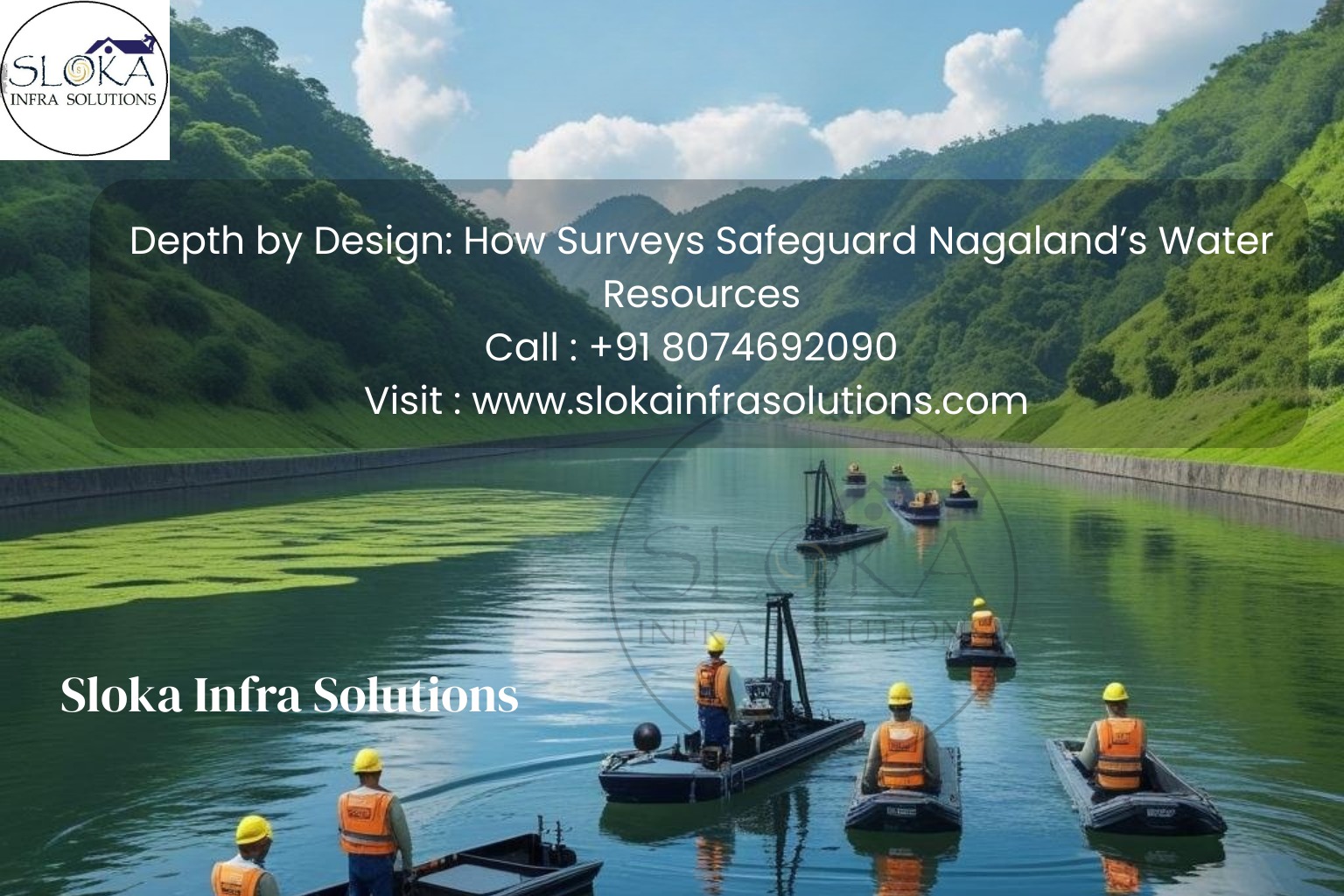
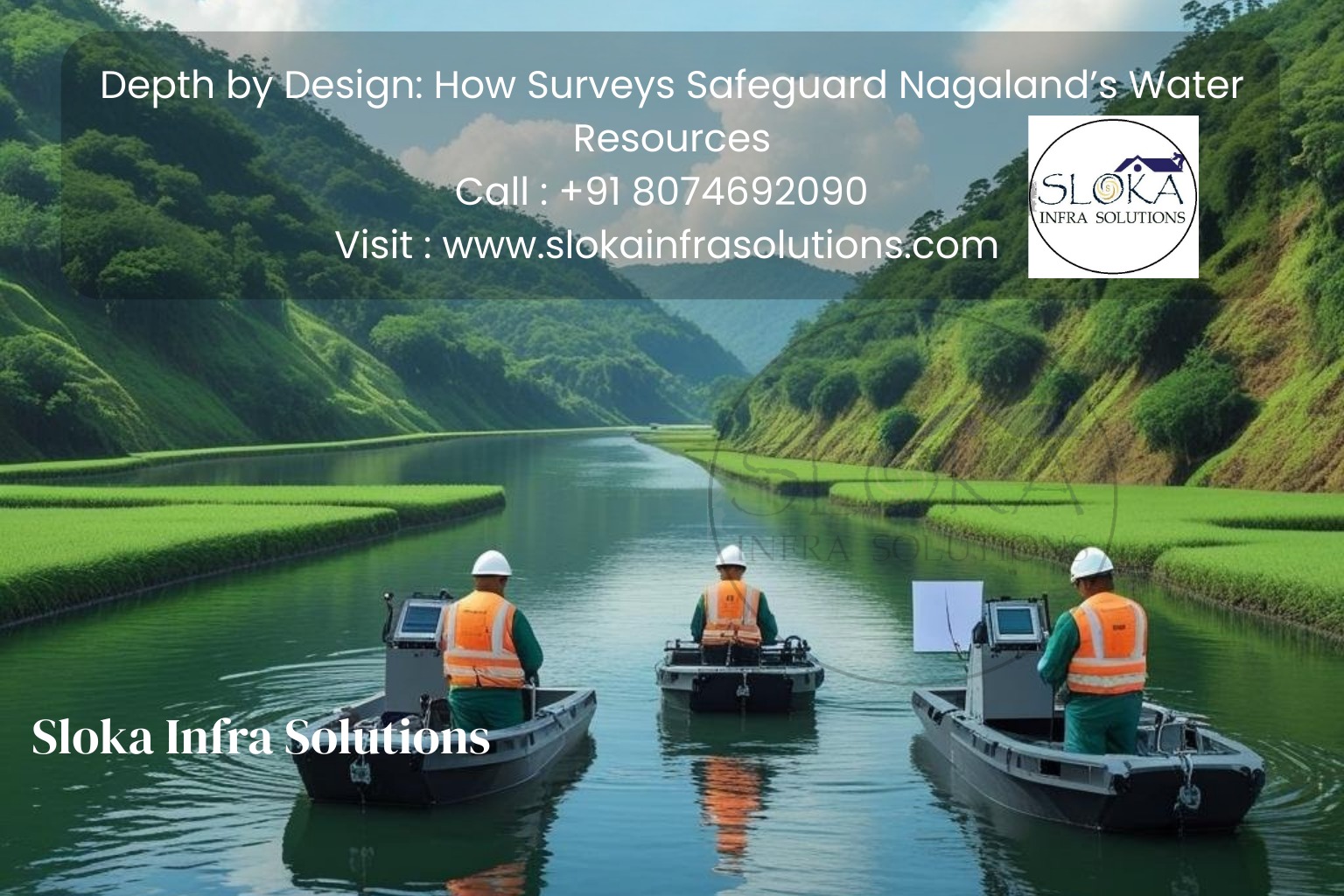
3.Platform selection — Choose platforms matched to the waterbody: inflatable boats or small survey launches for reservoirs and larger lakes; shallow-draft catamarans or even kayak-mounted systems for small lakes and wetlands; drift-capable craft for rivers. Low-draft gear reduces disturbance in shallow or vegetated areas.
3.Instrumentation mix — Modern bathymetry pairs multibeam or single-beam echosounders (for depth), GNSS receivers (for robust positioning), and sometimes side-scan sonar or sub-bottom profilers (to image the near-surface seafloor and subsurface layers). Data loggers and real-time processors are essential to monitor data quality during acquisition.
Survey design — Lay out survey lines (transects) to meet resolution objectives: tighter line spacing in zones where bathymetry changes rapidly (inlets, channels, littoral zones), and coarser spacing in deeper, uniform basins. Factor in seasonal flows — monsoon months may be risky for fieldwork and can distort bed morphology; dry-season surveys often yield safer, repeatable results.
Calibration and QA/QC — Perform sound-velocity profiling where necessary, draft and transducer offset calibration, and baseline checks against known depths or spot soundings. Good QA/QC reduces post-processing headaches and increases confidence in final depth models.

Equipment primer (what you’ll commonly see in the field):-
Single-beam echosounder — good for linear transects and small budgets; yields accurate depth at a point beneath the vessel.
Multibeam echosounder — produces swath maps of depth for high-resolution coverage of lakes and reservoirs.
Side-scan sonar — creates detailed images of the seafloor texture and objects lying on it (covered more below).
Sub-bottom profiler — penetrates subsurface strata to reveal buried layers and sediment thickness (covered more below).
GNSS (RTK/PPK) — high-accuracy positioning that ties soundings to real-world coordinates.
Sound velocity profiler — measures how sound speed varies in the water column; necessary for accurate depth corrections.
Portable platforms — inflatable boats, shallow-draft catamarans, kayaks or even small unmanned surface vehicles (USVs) for confined or sensitive habitats.
Sub Bottom Profilers:-
Sub-bottom profilers are the acoustic tools that let surveyors read beneath the seabed (or lakebed) like a medical ultrasound reads under skin. Where a standard echosounder only measures the distance to the seafloor, a sub-bottom profiler (SBP) transmits a lower-frequency acoustic pulse able to penetrate loose sediments and reflect off buried layers and compacted substrates. The returned echoes are recorded by hydrophones and processed to reveal a cross-section of stratigraphy — layers of silt, sand, compacted clay, buried channel fills, or anthropogenic deposits.
In Nagaland, SBPs are especially useful for reservoirs and slow-moving river reaches that accumulate sediment behind dams or in low-energy pools. For example, understanding the thickness and distribution of silt in a reservoir helps estimate lost storage capacity and informs dredging prioritization. In river systems, SBP data can reveal former channels, sandbars buried under recent deposits, or zones of rapid sedimentation that might alter flood behavior. Combined with sediment sampling, SBP profiles let geoscientists estimate deposition rates and identify materials — crucial for long-term water resources planning.
Operationally, SBPs come in different flavors: chirp systems that sweep across a range of frequencies for better vertical resolution, and high-energy pingers for deeper penetration but lower resolution. The selection hinges on how deep you need to go, the kind of sediment beneath the water, and the level of detail you want to capture. Interpretation is part art and part science: features must be correlated with grab samples or cores to confidently label layers. When integrated with bathymetric depth models and side-scan imagery, SBP data complete a three-dimensional picture of both the surface and subsurface — a powerful combination for reservoir managers, environmental assessments and engineering designs.

Side Scan Sonar:-
Side-scan sonar (SSS) works like the visual storyteller for depth-measuring tools.. Instead of giving a point depth, it paints a textured image of the seafloor — revealing roughness, ripples, boulders, debris, vegetation mats, and man-made objects. It does this by towing a sonar “towfish” or mounting a transducer array on a hull; acoustic pulses fan out to the sides and the intensity of returned echoes creates a high-contrast image where features cast acoustic “shadows” and textures show material differences.
For Nagaland’s rivers and reservoirs, side-scan sonar provides value in several practical ways. In reservoirs, SSS can quickly locate sediment lobes, submerged vegetation zones, or obstructions near intakes that could compromise pumps. In rivers, it identifies large woody debris, submerged boulder clusters, and abrupt changes in bed texture that influence turbulence and habitat. Where fisheries are a concern, SSS images help spot submerged structure that supports fish aggregation.
SSS is highly efficient for covering large areas and for target detection, but it does not measure depth directly; it complements bathymetry by explaining what the bathymetric shapes are made of or what lies on them. Interpretation requires attention to range, tow height, and grazing angles: too high and resolution drops; too low and the footprint shrinks. Paired with multibeam bathymetry and sub-bottom profiling, side-scan sonar completes the full picture—revealing depth, surface textures, and layers beneath—offering stakeholders a detailed dataset to better manage water resources, ensure safe navigation, and support habitat restoration efforts.
Fieldwork considerations specific to Nagaland:-
Seasonality and monsoon risks — Nagaland’s monsoon months bring heavy, rapid runoff that can be dangerous for small survey vessels and can dramatically alter bedforms. Plan surveys in dry or post-monsoon windows when flows are manageable and visibility and access improve.
Access and community engagement — Many waterbodies are village-managed; securing permissions from local councils, explaining objectives in local languages, and involving local boat operators speeds logistics and builds trust.
Variable water clarity — Sediment-laden rivers reduce the effectiveness of optical methods; acoustic systems (echosounders, SBP, SSS) remain the workhorse. In very shallow, vegetation-dominated wetlands, use shallow-draft platforms or pole-mounted echosounders.
Safety and emergency planning — Steep banks, hidden underwater snags, and sudden drop-offs require conservative safety margins, redundant communications, and life-saving gear.
Data backup and metadata — Maintain rigorous metadata (time, GNSS quality, vessel draft, transducer offsets, sound speed profiles) and back up raw data daily. Good metadata makes later reprocessing and future comparisons possible.
Applications and benefits tailored to Nagaland:-
Reservoir management — Estimate live storage lost to siltation; optimize dredging or sediment-trap interventions; locate safe intake placements free of sediment-laden flows.
Flood risk and river engineering — Feed hydraulic models with accurate channel geometry to predict flood extents and design bank stabilization.
Fisheries and ecology — Identify habitat structures and depth refugia for fish; plan stocking strategies or habitat enhancements.
Infrastructure planning — Design bridge piers, culverts and intake structures using accurate channel cross-sections.
Cultural and tourism uses — Map sacred lakes and boatable areas for safe tourism experiences around features like Shilloi Lake and other scenic waterbodies.
Common challenges and how to mitigate them:-
Access and permissions — Early engagement with local stakeholders and village councils minimizes delays.
Rapid morphologic changes — Schedule repeat surveys and maintain a baseline archive for trend analysis.
Budget constraints — Prioritize critical zones for high-resolution multibeam work, and use single-beam or small-boat surveys for low-priority areas.
Technical skill gaps — Combine local technicians with experienced hydrographic teams, and invest in training for data processing and interpretation.
Environmental sensitivity — Use low-impact platforms in fragile wetlands and follow local conservation rules.
How to choose the right survey partner (what to look for)?
If you’re commissioning a survey in Nagaland, look for partners who demonstrate:
Proven experience in inland freshwater surveys and reservoir studies.
A clear plan for field safety, permissions and community engagement.
Transparent data management and deliverable standards (raw archives + processed products).
Ability to integrate acoustic datasets (bathymetry, SBP, SSS) and to ground-truth with sediment sampling.
Local logistical capabilities or partnerships to reduce timeline and cost
While technical capability is vital, equally important is respect for local customs and the ability to coordinate with village councils and district authorities.
Conclusion:-
In conclusion, Bathymetric Survey in Nagaland stands as a vital foundation for managing the state’s diverse rivers, lakes, and reservoirs with precision and foresight. By working with a Top Bathymetric Survey and Surveyor in Nagaland who blends cutting-edge technology with deep local understanding, communities and decision-makers can protect water resources, plan resilient infrastructure, and preserve aquatic ecosystems for generations. From safeguarding reservoir capacities to supporting fisheries and preparing for monsoon-driven challenges, accurate underwater mapping is not just technical data—it’s an investment in Nagaland’s environmental security and sustainable future.